

SPONSORED: The Clark Foundation — A legacy in legal education

The Clark Foundation has been opening doors to legal training for 35 years. Five funding recipients explain how the grants have helped their careers.
The Clark Foundation for Legal Education has supported valuable work in legal education over the last 35 years. Here, we find out how the charity began, hear from some of its beneficiaries, look to the future and examine the ongoing MiniTrials initiative focusing on schools.
To begin, it is only fitting that we focus on the Clark Foundation’s founder, Jean Clark MBE, who also served as Chair of the Clark Foundation from its establishment in 1991 until her death in January 2001. Jean’s legal adviser and friend, John Fulton (who for many years was one of the Clark Foundation’s trustees, and would go on to become its Chair between 2017 and 2024), tells us:
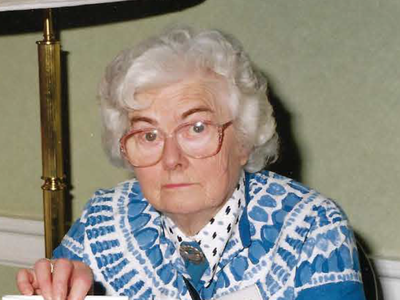 “Jean was born in Troon in 1918, but her family’s roots lay in Kilmarnock, where her forebears had established Saxone, a highly successful shoe manufacturer and retailer. The business was not for Jean, however, who attended Edinburgh University, graduating with an MA LLB in 1942 before going on to practise as a solicitor for many years. That changed in 1967, when a far-sighted president of the Law Society of Scotland appointed Jean to be the Deputy Secretary of its embryonic Public Relations Department, which would later become the Postgraduate Education Department.” The department was enormously successful and Jean would remain in this post until her retirement.
In the mid 1980s, Jean, now retired, became a client of John Fulton along with her sister, Elizabeth. In 1990, Elizabeth sadly passed away and Jean and John were the executors of her estate. John recalls to us that “after being informed of the sum due to Jean under her sister’s will, Jean looked at me and said: ‘John, I don’t need this money. What am I going to do’.” A few weeks later, after much thought, John suggested the idea of setting up a trust for legal education and outlined the proposed structure. Jean’s response was “immediate and positive”.
Jean and John sought advice from trusted friends and colleagues who provided “vital reassurance”. The Clark Foundation is grateful to those who were enthusiastic and willing to be involved – alongside Jean and John – at this crucial moment. They were Kenneth Pritchard OBE; Lord Johnston, then Dean of the Faculty of Advocates; and Tom Drysdale, Deputy Keeper of the Signet. The Clark Foundation had passed its first test and would go on to be set up as a charity.
John recalls that the work of the Foundation then began under Jean’s “excellent and considerate chairmanship. This, as with any dealings with Jean, was done with efficiency, common sense, a deep interest in others and, no less importantly, an ever-present sense of humour. She was always keen to see the Foundation help both men and women who were motivated to improve themselves in a manner that offered benefit to others in society. Single women seeking to enter the profession were of particular concern to her as Jean would have known, from her own personal experience, how challenging entering a profession dominated by men could be”.
The Clark Foundation’s two main objectives were to advance the legal training of those practising or intending to practise law, and to support those teaching law in Scotland or elsewhere in the world; and to promote good citizenship and civic responsibility. It continues to strive towards these goals today.
Jean generously used her wealth to support many good causes and charities – for which she would go on to be awarded an MBE. Following her death in 2001, she left additional funds to the Clark Foundation so it could continue to promote the Law of Scotland and support lawyers. It now has a fund valued over £2.6m and generates an annual income that is available for making the awards and fulfilling other purposes of the Trust.
International impact
Since it was set up, the Clark Foundation has awarded over 600 grants to individuals, organisations, projects and events. Past recipients are now Senators of the College of Justice, King’s Counsel in Scotland and England, and academics at law schools in Scotland and further afield.
The Foundation has funded seminars for students, university researchers and practitioners. Students have received funding to study private law in Salzburg and to take part in negotiation competitions in Tokyo. Award holders have held internships at courts in Europe and at law firms in Africa, Asia and the United States. The Foundation has funded research on topics from the institutional writers to space law and from the law of conflict to the conflict of laws. It has supported books ranging from a translation of Craig’s Jus Feudale to the Scottish Feminist Judgments Project. It has funded events ranging from CPD for newly qualified solicitors to lectures from Justices of the Supreme Court and the reenactment of historic criminal trials.
To illustrate just how much of an impact the Clark Foundation has made on people’s lives and careers, five recipients of funding – Almira Delibegović-Broome KC; Jamie McGowan, advocate; the Scottish Young Lawyers’ Association, Professor Andrew Steven; and MiniTrials – have kindly provided some insight into how their award has supported them.
Fast track to legal success
Almira Delibegović-Broome KC says of her experience with the Foundation: “I applied to the Clark Foundation in 1995 to cover my Diploma in Legal Practice tuition fees at Edinburgh University. At that time, I was still an asylum-seeker, having arrived in Scotland in 1992 from the war-torn Bosnia-Herzegovina. I believe the funding situation for asylum seekers is different now, as they are entitled to university funding in the same way as Scottish students. That was not the case then, though. The first three years of my studies at Edinburgh were funded by a combination of sponsorship from Balfour & Manson and the University’s own Hardship Funds.
“I managed to complete the LLB (Hons) degree in three years, rather than four, rushing to complete my education and get into the job market – anyone who has been in a similar situation will know what responsibility one feels when one is in receipt of charity. I wanted to stop being a burden on anyone and make ends meet for myself.
“Before the end of my LLB, I managed to secure a traineeship offer – I was on course to achieve a First-Class degree and obtained further exam passes with the Law Society of Scotland for all the subjects I needed, but could not accommodate within my ‘concertinaed’ three-year Honours degree. This was where the Clark Foundation was so crucial for me – then and for my future life. Without the ability to complete the Diploma course, I would not have been able to start my legal career at all. By so generously giving me a grant, the Clark Foundation made it possible for me to take the final stage of the journey to becoming a trainee and, in due course, a fully qualified lawyer.
“I am now a King’s Counsel at the Scots Bar. I have had an interesting, enjoyable and varied legal career, interleaved with further academic study and research a couple of times at Harvard Law School (in a way perhaps seeking to compensate for that time when I ‘rushed out’ of university to start work!).
A number of amazing individuals, funds and institutions helped me on my journey, and the Clark Foundation was central among them, for which I am immensely grateful and indebted. I try to repay that debt in whatever way I can, including through my own voluntary and charitable work. I hope that my legal career in itself, and any contribution I may have made in it to Scots law or the outcomes of those I represent, is a way of thanking the Foundation, as well as the others that have supported me along the way.”
Shaping a career at the bar
The trust’s help made advocate Jamie McGowan’s legal career possible. He explains: “The Clark Foundation supported me throughout my doctoral studies at the University of Glasgow. While I was doing my undergraduate degree, I developed a keen interest in public law and wanted to do a further research degree in constitutionalism. However, having come from a care-experienced background, I would never have been able to do a PhD without funding. The grant from the Foundation allowed me to begin my PhD studies, which have provided me with many opportunities to publish and present my research at home and abroad.
“Now, I am an advocate at the Scottish Bar, where my practice is mostly in public and administrative law. Naturally, my doctoral studies have been crucial to my career at the bar, where I am able to put research into practice. I am grateful to the Clark Foundation for having given me assistance when I needed it most – without it, I would not benefitted from so many opportunities that have come my way since.”
Enabling educational events
The trust has supported the Scottish Young Lawyers’ Association to deliver a variety of events. A representative says: “Over the years, the Clark Foundation has been a great source of support. It has assisted us in delivering education-focused events to our members that we would otherwise have been unable to produce. A good example of this work in action is the SYLA/Clark Foundation Ethics Conference – a series of events, delivered by legal professionals, which assists members in meeting their ethical and regulatory TCP requirements (and offers an accessible alternative in the market, free of charge). We are very grateful to the Foundation for its continued support and look forward to working with it in the years to come.”
Fostering unity and diversity
Professor Andrew Steven explains how a chance conversation led to more than two decades of Clark Foundation-funded opportunities for Edinburgh students at the Salzburg Summer School.
“In 2004, I was invited to lecture on Scots law at the European Private Law Summer School at Salzburg in Austria. The Summer School was founded in 2000 by Professor Michael Rainer. Its theme is ‘unity in diversity’ and it has the aim of introducing law students to the rules of private law – particularly contract law, family law and property law – in other legal systems. Scotland is regarded as important here because it is one of a small number of mixed legal systems that are heavily influenced by both Roman law and English common law.
“The Summer School is perhaps best compared with the Eurovision Song Contest but with each country providing a lecture rather than a song. There are also workshops where students compare the law in different countries in relation to problem-type questions. All this takes place in the centre of Salzburg, a UNESCO World Heritage Site.
“Professor Rainer thanked me for my lecture and invited me to return in 2005, saying: ‘Please, however, bring some students.’ I thought about this but also of the costs, including the course fee, travel and accommodation. Sometime later I was speaking to John Fulton, then chair of the Clark Foundation. I knew him from my traineeship at Tods Murray. He asked me if the Foundation’s posters inviting applications for funding could be seen on notice boards at Edinburgh Law School. I said ‘yes’ because I had noticed them. Mr Fulton commented that few applications were being made by students.
“This gave me an idea. I applied to the Foundation for funding for students to attend the Summer School. I was successful and the first three Edinburgh students attended in 2005.
“Over the last 20 years, over 100 other Edinburgh students have been supported by the Foundation to attend the Summer School, in addition to funding from the University of Edinburgh itself. On the experience of attending, it is best to hear from some of the alumni.
“My now colleague, Dr John MacLeod, attended in the first group of 2005. He says: ‘The Salzburg Summer School opened my eyes: it showed me that lawyers from different systems could learn from one another, that people from other jurisdictions were interested in Scots law and that dialogue between systems could be fun.’
“Aimee Brown, now a fourth-year law student, attended in 2024 and says: ‘The Salzburg Summer School was an incredible experience that has had a real impact on my academic and professional journey. The programme gave me more than just legal knowledge — it was a chance to push myself in new ways. Whether it was learning about different legal systems, navigating cultural difference, or picking up bits of new languages, it helped me grow in confidence and adaptability.’
“The support of the Foundation in achieving this impact is much appreciated by the students and me.”
MiniTrials success story
Among the numerous other projects supported by the Clark Foundation is MiniTrials, an ongoing initiative by Scottish lawyers to help schools find out more about the Scottish legal system, simulating court cases and designed to be conducted by secondary schools in Scotland.
A representative from MiniTrials explains: “MiniTrials has worked alongside the Clark Foundation for many years. The Clark Foundation works closely and on a regular basis with the MiniTrials Steering Group. It really understands the aims of MiniTrials and offers advice when required on the advancement of the organisation. In the last few years alone, it has assisted in the funding of two posts within the Steering Group – a secretary and a social media manager. It has also aided with modernising the website and supported a video production to create advertising material. The Foundation also regularly funds the supply of lunches for the school pupils at the Edinburgh inter-schools MiniTrials event held in October each year. Its assistance has been instrumental in helping MiniTrials thrive. We look forward to continuing our work with it for many years to come.”
Acknowledgments
The Clark Foundation Trustees wish to thank the applicants who have contributed to this article – Almira Delibegović-Broome KC, Professor Andrew Steven, Jamie McGowan, the Scottish Young Lawyers’ Association and MiniTrials.
We also take this opportunity to pay special thanks to John Fulton. John contributed to this article, and also played an important role in the creation of the Clark Foundation and was actively involved until his retirement as chair in 2024.
Application information
The Clark Foundation is in the fortunate position of being able to support a wide variety of initiatives in line with the trust’s purpose. Applications are assessed based on merit and they are reviewed by the Clark Foundation’s Legal Education Advisory Committee, which provides invaluable assistance to the Foundation.
You could receive funding to develop your career through legal education, launch a new initiative, fund IT support, support a project or event, undertake research, assist students, promote good citizenship and civil responsibility… the list goes on. We hope that Jean’s legacy can live on for generations to come and The Clark Foundation very much welcomes applications.
Applications for funding are open until 31 March 2026.
More information regarding the Clark Foundation and applying for support can be found here Clark Foundation for Legal Education | Supporting lawyers who wish to further their studies.
Weekly roundup of Scots law in the headlines including Cape Verde stomach bug legal action — Monday April 13
The technological lawyer in the age of AI
Out of office or out of control? Why absence makes the risk grow stronger for solicitors
Additional





Journal issues archive
Find all previous editions of the Journal here.