

Financial review and governance
Overview and principal activity
The Law Society of Scotland is the professional body and regulator of Scottish solicitors.
We provide a range of support and services to more than 14,000 members to help ensure the Scottish solicitor profession and wider justice sector can thrive. We also protect the public interest and reputation of Scottish solicitors by setting and enforcing high standards through robust regulation. We also have a wider role, domestically and internationally, in protecting the rule of law, the independence of the legal profession, and access to justice for those in need. In doing so, we argue strongly for good law making and public policy decision making.
As an organisation, the Law Society was established by statute in 1949. Our core legislative framework is set out in the Solicitors (Scotland) Act 1980 as amended by other more recent acts of parliament
By law, all practising solicitors must members of the Law Society. We also provide other voluntary forms of membership and authorisations, including registered foreign lawyers and accredited paralegals.
The Council of the Law Society acts as our principal strategic decision making body and is made up of elected and appointed solicitor members, as well as lay public interest members. By law, our regulatory functions are delegated to a Regulatory Committee which is made up of 50% lay and 50% solicitor members. Many of our regulatory and non-regulatory work is delegated to committees of the Council and sub-committees of the Regulatory Committee.
At an executive level, we have around 170 staff who work across five directorates covering:
regulation
member services and engagement;
education, training and qualifications;
external relations;
finance and operations.
All work aligns with our current strategy which commenced in 2022 and sets five key aims:
Supporting our members to thrive
Modern and effective regulation acting in the public interest
Innovation and efficiency
Influential voice that enhances our legal sector and justice
Leading the profession
We produce an annual plan each year which sets out the key specific projects we need to take forward to delivery against our strategic aims. The annual report does not form part of these financial statements, is not subject to review by independent auditor and can be found on our website.
As part of our statutory regulatory role, we also control and administer the Client Protection Fund, the operating name of the Scottish Solicitors' Guarantee Fund (SSGF). The Fund, established under the Solicitors Scotland Act (1980) exists solely to protect clients who have lost money as a result of dishonesty of a solicitor or a member of their staff in connection with the practice of the solicitor. It is paid for entirely by solicitor firms without the use of taxpayer money from government. The Fund is only available to clients who use solicitors who are employed by legal firms regulated by the Society.
Review of financial year
Group
In compliance with Financial Reporting Standard 102, the Society’s financial statements have been consolidated with those of the Scottish Solicitors’ Guarantee Fund (SSGF) and with The Law Society of Scotland Services Limited (non-trading entity) and presented as financial statements for the Group. The statutory basis, day-to-day management and governance oversight of the SSGF is unaltered by consolidation. The SSGF is included within the consolidated financial statements in recognition of the Society exercising control over the management, governance and operation of the Fund.
As required by statute, all income received by the SSGF is legally ringfenced to meet only future claims and therefore not available under any circumstances for the Society’s use. Similarly, the reserves of the SSGF are legally designated for that purpose and do not under any circumstances form part of the Society’s free reserves. Control of the SSGF is, however, bestowed on the Society by law, and, more widely, the SSGF is considered to be of benefit to the Society in helping underpin the positive reputation of the profession.
Profit (prior to actuarial adjustments to defined benefit pension scheme) - Group
The Group reports a profit (prior to the actuarial adjustments to the defined benefit pension scheme) of £2,168,000 for the financial year ended 31 October 2025 (2024: profit of £2,360,000). This comprises the following components:
| 2025 £000 | 2024 £000 |
Law Society of Scotland | 1,944 | 1,626 |
The Law Society of Scotland Services Limited | - | 9 |
Scottish Solicitors’ Guarantee Fund | 224 | 726 |
Total – Group | 2,168 | 2,360 |
Profit reported by the Group after actuarial adjustment was £2,413,000 (2024: profit of £2,050,000).
Investments - Group
The Group’s investment portfolios reflect the improved performance of financial asset values during the year, with market values as at 31 October 2025 as follows:
| 2025 £000 | 2024 £000 |
Law Society of Scotland | 4,046 | 3,582 |
The Law Society of Scotland Services Limited | - | - |
Scottish Solicitors’ Guarantee Fund | 6,096 | 6,070 |
Total – Group | 10,142 | 9,652 |
Cash and current investments - Group
Cash balances and current investments for the Group as at 31 October 2025 were as follows:
| 2025 £000 | 2024 £000 |
Law Society of Scotland | 21,271 | 20,106 |
The Law Society of Scotland Services Limited | - | 4 |
Scottish Solicitors’ Guarantee Fund (not available for the Society’s use) | 2,177 | 1,865 |
Total – Group | 23,448 | 21,975 |
Reserves - Group
Group Reserves increased from £15,897,000 to £17,415,000 at the year end. The breakdown is as follows:
2025 £000 | 2024 £000 | |
Law Society of Scotland | 9,336 | 8,042 |
The Law Society of Scotland Services Limited | - | - |
Scottish Solicitors’ Guarantee Fund | 8,079 | 7,855 |
Total – Group | 17,415 | 15,897 |
Reserves held by the SSGF are legally designated solely for the purposes of the SSGF and are not available to the Society. At 31 October 2025 the SSGF reserves were £8,079,000 (2024: £7,855,000).
The Society’s reserves increased from £8,042,000 to £9,336,000 at the year end. The principal reason for this movement was net operational surplus, investment gain and dividend income mitigating impact of FRS102 amendment adoption with £0.8m of reserves reclassified as deferred income.
The Society
Profit reported by the Society after actuarial adjustment was £2,189,000 (2024: profit of £1,528,000).
The Society reports a profit (prior to the actuarial adjustments to the closed final salary pension scheme liability) of £1,944,000 for the financial year ended 31 October 2025 (2024: profit of £1,838,000)
A gain of £354,000 (2024: gain of £393,000) in the value of the investment portfolio held by the Society is included in the reported profits. We are investing in funds for the longer term and the portfolio is managed according to defined criteria. The investment objective is to achieve a balanced return, seeking long term capital gains and some income. A medium risk profile is adopted.
Overall, we exceeded expectations at an operating level compared both with the budget set, and against the prior year, with an operating profit of £1,078,000 (2024: £539,000). Revenue uplift has positioned the Society to weather inflation increases already suffered and to adequately fund reserves to support the implementation of the Regulation of Legal Services (Scotland) bill and support required for infrastructure transformations. Operational expenditure has increased in line with increased activity and improved resource management has seen a reduction in vacancies; however, this remains challenging in a competitive recruitment market where delayed recruitment has created a financial upside. One of the main items in our Income Statement is the unrealised movements in investment values, and the general improvement in financial asset values during the year is reflected in the overall result for the Society, as outlined above.
Operating income – Society
Income for the year (excluding investment gains) was £17.3 million, an increase of 10% from the previous year. Income is analysed as follows:
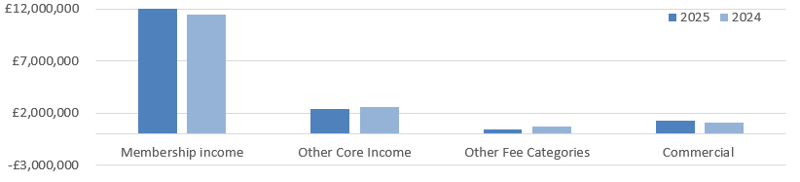
Membership income comprises full practising members (through the issuing of practising certificates), fees from being retained on the official roll of solicitors and non-practising member fees. Other core income comprises fees from regulatory activity. This includes the accounts fee paid by firm principals towards financial compliance and interventions and, the anti-money laundering fee which is charged to specifically cover the costs of our role as an authorised anti-money laundering regulator. We also receive income via recovery of costs awarded to us by the Scottish Solicitors Disciplinary Tribunal, and commission and recoveries from Judicial Factories.
Fees uplift for practise year 2024/25 and 2025/26 are comparatively modest compared to previous years, this is reflective of our current reserves position and operating in an economy that has improved but remains challenging.
Operating expenditure – Society
Expenditure (excluding actuarial movements in closed pension scheme) was £16.3 million (2024 £15.2 million), an increase of 7% from 2024. Expenditure is analysed as follows:
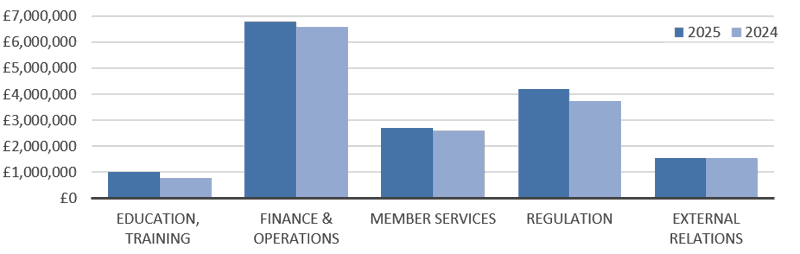
In 2024/25 operating costs increased compared with the prior year across most areas, reflecting increased activity, particularly within our regulation team in preparation for the passing of the Legal Services Bill which will require substantial changes to our regulatory work and governance. Additionally, whilst continuing to practice good cost control, inflationary pressures across the cost base, for people, programmes and operations, have also contributed to the overall expenditure increase compared with the prior year, particularly with the essential investment in IT infrastructure and security.
Pension debt and actuarial movement
The Society is responsible for a defined benefit pension scheme which was closed to future accrual from 1 May 2010. The most recent full actuarial valuation was carried out on 31 March 2022 by a qualified actuary, independent of the scheme's sponsoring employer.
The overall deficit shown by most recent triennial valuation on 31 March 2022 was £800,000 (March 2019: £1,423,000) with the value of assets covering 92% (March 2019: 86%) of the value of the liabilities. The main reasons for the improvement in the funding level were the contributions paid by the Society over the intervaluation period, combined with better than expected investment returns, higher interest rates and gains on member settlements. These factors were partly offset by changing market conditions, mainly higher inflation rates with the overall net effect resulting in an increase in assets and a reduction in liabilities.
The deficit recovery repayment plan agreed in 2017 has resulted in aggregate contributions of £1,559,000 in the three years to March 2020. The Society meets the scheme running costs as they fall due. The Society finalised negotiations with the scheme trustees in August 2020 to determine the next recovery plan. Following the finalisation of the March 2019 triennial valuation in 2020, the next recovery plan was agreed covering a ten-year period. £170,000 was paid in March 2020 as year 1 of the revised plan. From March 2021 for nine years, £99,000 will be due to be paid annually, increasing at a rate of 5% per annum, with £109,000 having been paid in March 2023 and £115,000 paid in March 2024. With agreement of the Trustees of the scheme, contribution payments were not paid in 2025. This is due to the performance of the fund, Trustees of the Scheme have agreed that contributions from the Society are currently not required, however, may be required in the future.
Financial Reporting Standard 102 applies less prudent assumptions than those in the triennial actuarial valuation (as explained in note 20). The valuation surplus is not carried as an asset in the financial statements as we do not have an unconditional right to any surplus funds remaining at the cessation of the scheme. The reasons for the change in surplus over the period are primarily the purchase of a bulk annuity policy by the Trustee on 8 May 2025, for which a proportion of invested assets were disinvested in order to pay for the premium for the policy. The actuarial valuation reported a gain for the year of £245,000 (2024: £310,000 loss)
At 31 October 2025 there was no scheme deficit for financial reporting purposes (2024: deficit £nil).
Reserves
The Society’s reserves increased from £8 million to £9.3 million at the year end. The principal reason for this movement was net operational surplus, investment gain and dividend income mitigating impact of FRS102 amendment adoption with £0.8m of reserves reclassified as deferred income.
Finance Committee approved an updated Operating Reserves Policy in March 2026. The purpose of the Operating Reserves Policy is to ensure the stability of the activities and ongoing operations of the Society in support of our strategy and annual operating plan. The Society’s policy for operating reserves (excluding designated SSGF reserves) is to hold between three and six months’ average operating cost for the Society. The policy makes provision for the lower end of this range, or the minimum target, to be varied to reflect changes in the overall business environment. The calculation of the monthly operating cost is based on projected expenditure in future periods.
Operating reserves cover calculation as at 31 October 2025:
£000 2025 | £000 2024 | ||
Total Capital Employed | 12,676 |
8,042 | |
Less: Net book value of fixed assets |
(4,974) |
(768) | |
Reserves per policy (A) | 7,702 | 7,274 | |
| |||
Projected operating and capital expenditure for the next 12 months - Society only (B) | 19,152 | 20,007 |
|
Number of months' coverage from reserves (A / (B/12)) | 4.8 months | 4.4 months |
|
The Operating Reserves Policy makes provision for a recovery period in the event that the use of reserves has been approved by Council and the supporting financial forecast indicate that two or more consecutive future year ends may see reserves measured below the minimum target level. During a recovery period, additional reporting and monitoring is required, including the review of a rolling 12 month forecast by the Finance Sub-committee and the Board on a quarterly basis. The above reserves cover calculation shows we hold sufficient reserves to meet the requirements of the reserves policy and so is not considered to be in a recovery period.
The Finance sub-committee reviews the appropriateness of the policy on an annual basis.
Law Society of Scotland financial statements 2024/25
Download the financial statements for the Law Society of Scotland, Law Society of Scotland Services Limited and the Client Protection Fund.

Governance report 2024/25
The Society's role
We are the professional body and regulator of Scottish solicitors. We have responsibility for promoting the interests of the solicitor profession in Scotland and the interests of the public in relation to the profession. Our responsibilities as a professional body and regulator are overseen by both our Council and our Regulatory Committee. The Council consists of up to 48 seats, of which 31 are elected solicitor members, up to nine lay members, eight co-opted solicitor members, and such ex officio members as may be required.
The UK Corporate Governance Code
We are a statutory body governed by the Solicitors (Scotland) Act 1980 with a constitution made under that Act and accompanying standing orders. We are committed to the principles of good corporate governance and seek to comply with the relevant parts of the 2018 UK Corporate Governance Code where it is practicable given our scale and operations.
Strategic management
Our governing body is the Law Society Council, which sets the overall strategy as well as the annual corporate plan and associated budget. In October 2022 we published a five-year strategy for 2022-27 which sets out how we will support members within a growing and well-regulated legal sector. It followed a two-year strategy implemented in 2020 in response to the Covid-19 pandemic. The Council manages the overall strategic direction for the Society within the context of the annual operational plan and annual budget. The Council also measures our performance against our annual operational plan within the context of our longer-term goals, as currently set out in our five-year strategy. The Council delegates the monthly oversight of our implementation of the annual operational plan to the Board. The Board is chaired by our President and is made up of the Vice President, Past President, up to six other elected Council members and one member with <10 years PQE at the time of appointment. Sitting beneath the Board is the Chief Executive, the senior leadership team, general counsel, and our managers, who all work together to implement the annual operational plan, deliver the organisation’s strategy, as well as managing the Law Society on an operational basis.
Governance
There are a number of checks and balances within our governance model which seek to ensure an appropriate and fair discharge of our statutory responsibilities as a professional body and regulator. These checks and balances include the monthly reporting of progress on the implementation of the annual operational plan to the Board and the Council. The regulatory functions of the Council are discharged by the Regulatory Committee through a delegated authority scheme in conjunction with the various regulatory sub-committees and our employees.
Our Audit Committee has, as one of its main roles, responsibility for reviewing and making recommendations on our internal control and risk management systems, in order to monitor and assess the effectiveness of those procedures and management and reporting systems. The convener of the Audit Committee reports to the Council on these matters as well as to the members at the annual general meeting. The Audit Committee also benefits from the provision of internal audit services provided by WBG.
We have a Finance Sub-committee, the convener of which sits on Council. The Finance Sub-committee has responsibility for producing and then presenting the annual budget for approval by the Council. The Finance Sub-committee also proposes the annual practising certificate subscription, first to the Council and then to members for approval at the annual general meeting. There is a Nominations Committee chaired by the immediate Past President, which oversees the system for the appointment of members to our committees as well as making recommendations to Council for the appointment of the conveners for such committees.
The Public Policy Committee is the principal representative committee in relation to the formation of public policy and law reform for the Society. Its modus operandi is now well established. This committee replaced the former Law Reform Committee. The principal role of the committee is to oversee all the public policy work that we undertake, and to ensure that it is in line with our strategy.
Office bearers
We have three office bearers: the President (who is the chairperson of the Law Society), the Vice President, and the Past President. Each of these three office bearers takes office for one year. The Vice President becomes President, with the handover taking place at the Council meeting in May. The office bearers, together with the Chief Executive, are our main ambassadors and represent the Law Society at home and abroad.
Chief Executive/Secretary
The role of the Chief Executive is to provide the leadership and vision necessary to enable the organisation to be a world-class professional body, effectively representing the interests of its members, whilst setting and upholding standards that strive for excellence and ensure the public can have confidence in the Scottish legal profession.
The Chief Executive is accountable for the strategy, planning, and good governance of the operational aspects of all that the Society is responsible for. The Chief Executive is also formally the Secretary to the Society and is ultimately accountable for its good governance and compliance with all relevant legislation, both the specific Acts which govern the organisation and the general legislation which affects any organisation (eg employment law; equalities legislation; health & safety; the General Data Protection Regulation). The Chief Executive needs to have positive relationships with senior individuals in third-party organisations, including government ministers; senior members of the judiciary; CEOs of partner/sectoral organisations.
Council
The Council’s responsibilities are set out in statute, the constitution and the standing orders. The principal role of the Council is to approve the strategy, annual corporate plan and the annual budget for the Society. The Council also sets the most significant fees for members as well as recommending the practising certificate subscription for members to consider. There is also a code of conduct which sets out the standards of behaviour expected of Council members. The Chair of the Council is the President. Greater details of our governance arrangements are available elsewhere on our website.
The Board
The principal roles of the Board are:
- to provide guidance to our executive on initial drafts of strategy and the annual corporate plan, which will include resource plans, before their submission to the Council for approval
- to provide direction to both the executive and committees on any strategic-level initiative or project before submission to the Council for approval
- to monitor the Society’s quarterly performance against our targets contained in the annual corporate plan and report any major variance to the Council
- to regularly monitor our financial performance against budget and to ensure that all risks identified in our risk register are managed and escalated to the Council for those which the Board considers to have the potential to have a high impact on the work of the Society, and with a medium to high likelihood of occurring
The Regulatory Committee
The principal roles of the Regulatory Committee are:
- to ensure that the standards for the profession are set by way of making relevant and appropriate rules and guidance, to be applied in a uniform and consistent way and regularly reviewed
- to ensure on an ongoing basis that the internal processes, policies and procedures adopted by the regulatory sub-committees are effective, appropriate and proportionate in order to ensure the making of consistent regulatory decisions for the protection of the public and the profession and to ensure that the sub-committees comply with Section 3B(2)((a) and (b)) of the 1980 Act
- where any rules policy, process or procedural changes are not in the authority of the Regulatory Committee to change, to make recommendations for any changes to the appropriate governance group in the Society (eg the Council; the Law Society Board; Finance Committee; Chief Executive) or, in the case of rules, to a general meeting of members and the Lord President
Gender pay gap report 2024/25
We have published our gender pay gap figures since 2018 in accordance with the statutory reporting regulations. The UK Government requires businesses and organisations with 250 staff or more to report their gender pay figures annually. With around 170 employees, we report voluntarily as part of our commitment to equality and inclusion.
You can read our most recent gender pay gap report below.

Annual report 2025
Read our annual report and financial statements for 2024/25.