

Modern and effective regulation acting in the public interest
We planned to deliver modern and effective regulation through ensuring: robust education, training and admission standards; our regulation is fair, proportionate, risk-based and independent; our regulation promotes and protects the public interest and public trust.
Projects 2024/25
| Action | Outcome | Complete/Not complete |
|---|---|---|
Licensed Legal Services Providers |
A decade of campaigning by the Law Society of Scotland has resulted in new legislation that will better protect legal services consumers and benefit Scotland’s legal sector. The Regulation of Legal Services (Scotland) Act 2025, which was passed by the Scottish Parliament in June 2025, makes a number of amendments to the Legal Services (Scotland) Act 2010 and we have considered the impact of those. In August 2025 the Law Society’s Regulatory Committee took the necessary decision to defer further work on Licensed Legal Providers until 2027, pending the implementation of the 2025 Act and to enable appropriate coordination and prioritisation of the extensive regulatory reforms to which that legislation will give effect. |
Not complete |
Reform complaints handling |
We reviewed and updated various conduct complaint processes throughout the year, with key procedure manuals also revised to ensure conduct complaints are handled efficiently and consistently. Significant unplanned work was carried out following changes to the Scottish Legal Complaints Commission’s (SLCC) eligibility process, ensuring complaints continued to be handled fairly. We began scoping how to improve our approach to Scottish Solicitors’ Discipline Tribunal (SSDT) work, while a new, structured approach to quality assuring work was developed to ensure more consistent throughput. During the course of the year we also progressed work in relation to the SLCC’s s36 action plan. This included recruitment, meeting targets and work relating to the Regulation of Legal Services (Sc) Act 2025. (While not within the scope of this annual report, the SLCC published a positive update report in April 2026, welcoming the progress made.) In light of the need to prioritise work relating to the Regulation of Legal Services Act, we postponed work on first-tier complaints. |
Complete |
Public trust/public interest |
In October 2025, the UK Government announced its decision to transfer AML supervision responsibilities from all professional body supervisors to the Financial Conduct Authority (FCA). We acted quickly to inform our staff and the wider profession of this decision. We also set out our robust opposition, warning that a one-size-fits-all approach will increase costs and bureaucracy. HM Treasury issued a consultation on future FCA powers and have tentatively indicated that a phased transition of AML responsibilities from the various professional bodies will commence in mid-2028 and will take place over 18 months. There is no indication of where the Law Society will be positioned in the transition timetable, and the FCA have stressed that the indicative timeframes could be extended. A Law Society working group continued to monitor the Post Office/Horizon Inquiry, including considering volume 1 of the final report, and continues to make further enquiries with relevant organisations. Another key area of work during 2024-25 included drafting and publishing new guidance on non-disclosure agreements (NDAs), following approval from the Law Society’s Regulatory Committee and the Lord President. This aims to assist solicitors on accepting instructions and advising on NDAs and confidentiality clauses. New rules and guidance on client assets, including trusts, which aim to increase protections for consumers, were drafted and presented to the Law Society AGM in June 2025, prior to coming into effect on 1 November 2025, with a further rule for firms on maintaining a central trusts register coming into effect in on 1 November 2026. |
Complete |
Proportionate and risk-based regulation |
With the support of the Office for Professional Body Anti-Money Laundering Supervision (OPBAS), we are working towards a number of internal enhancements in key areas, such as streamlining the inspection process, intelligence management, aspects of AML governance, data quality, training and website management. Rules relating to incidental financial business (IFB) and AML were implemented following approval by the Regulatory Committee and the Lord President. The new IFB rules had also been agreed by the FCA in advance of the rules being considered at the Law Society’s AGM in June 2025. We communicated with the profession on these changes following the AGM. |
Complete |
Route to Qualification Review We will continue to explore viable alternative routes to qualification. |
Our project to explore changes to our alternative routes to qualification was not taken forward as, while the Society’s Education and Training (Standards Setting) Sub-Committee continued to consider routes into the profession on a regular and ongoing basis, no formal decisions were made on the most appropriate next steps. |
Not complete |
Regulation of Legal Services (Scotland) Bill We will begin the transformation of the regulation of legal services in Scotland after the Regulation of Legal Services (Scotland) Bill is enacted. |
The Regulation of Legal Services (Scotland) Act 2025 received Royal Assent in June but no provisions from the Act were in force during the period of this annual report. The regulatory transformation programme of work is developing in consultation with external stakeholders as the proposed staged implementation of the Act progresses. This will be dependent on commencement by the Scottish Parliament. To ensure an effective transition, we recruited a Head of Regulatory Transformation to manage the transformation programme and an Information Governance Manager to lead the Society’s data protection work and ensure we will be fully compliant with our new Freedom of Information duties. |
Not complete |
Judicial Factors (Scotland) Bill |
The Judicial Factors (Scotland) Act 2025 was passed on 10 December 2024 and received Royal Assent on 27 January 2025. We supported the legislation which will modernise the law around judicial factors and provide for significant improvements when such arrangements are needed to safeguard money and other assets. An internal review of the current Judicial Factor appointment processes/styles has been carried out and the required amendments identified. However, as there is no commencement date for the Act yet, implementation of the required changes will be carried out at a future date once this is known. |
Not complete |
Admissions Regulations We will seek to amend the Admission as Solicitor (Scotland) Regulations 2019, in line with the changes proposed by the Admissions Sub-Committee, following a review of those Regulations, and conditional on the concurrence of the Lord President. |
We had already undertaken some consultative work in advance of this year’s fourth quarter, with the most significant aspect remaining being the training contract consultation, which has now been completed. Respondents to that consultation appear to be in favour of the Society ceasing to register training contracts.We will continue our work into the next practice year 2025/26 on amending the Admission Regulations. |
Complete |
Regulatory Committee annual report 2024/25
The Regulatory Committee has had another busy year executing and delivering the Law Society’s regulatory function and contributing to regulatory strategy and policy.
Read more about the committee's work during 2024/25.
Read more about the Regulatory Committee's work
The Regulatory Committee has had a highly productive and strategically focused year, successfully fulfilling the Law Society’s core regulatory responsibilities while also making substantial contributions to the development and refinement of wider regulatory strategy and policy. Through its rigorous oversight, evidence-based decision making, and commitment to maintaining high professional standards, the Committee has continued to play a leading role in supporting the Law Society’s mission to uphold public confidence in the legal profession.
Regulation of Legal Services (Scotland) Act 2025
June 2025 saw the passing of the Regulation of Legal Services (Scotland) Act 2025—an important milestone following a decade‑long campaign by the Society for modernised legislation that better reflects today’s legal services landscape and consumer expectations. The new Act strengthens the regulatory framework, enhances protections for consumers, and supports Scotland’s legal profession to continue thriving on an international stage.
The 2025 Act also bolsters the committee’s independence and increases transparency. It introduces a wider range of regulatory powers, including the ability to investigate complaints against solicitors more quickly, impose suspensions from practice, and regulate at the entity level.
The committee looks forward to working collaboratively with the Scottish Government and all legal sector regulatory partners as the 2025 Act comes into force and implementation progresses in 2026.
Licensed Legal Services Providers (LLSPs)
The 2025 Act provides sweeping reforms to the way the existing solicitor profession is to be regulated. It also makes changes to the make-up of Licensed Legal Services Providers (LLSPs) and how they are to be regulated. In light of these significant regulatory changes, and after very careful consideration, the committee agreed to defer further development of the LLSP scheme for two years, until 2027. This temporary pause will allow the Society to prioritise delivery of key parts of the new 2025 Act in the short term. This includes work on a whole new system of business level regulation of 1,200 existing law firms and implementing the improvements to the complaints system. Whilst remaining committed to establishing the LLSP framework in medium term, the committee recognises that limited interest from firms makes it right to focus resources initially on where we know we can make the biggest difference and deliver the greatest benefits to consumers and the wider profession.
Non-disclosure agreement and confidentiality clause guidance
The committee acknowledges that non‑disclosure agreements and confidentiality clauses can serve legitimate purposes but also recognises the potential for misuse—an issue that has attracted considerable public concern. In response, the committee approved new guidance in October 2025 to help solicitors understand their professional responsibilities when negotiating, drafting, advising on, or enforcing such agreements. The guidance outlines key considerations, highlights common risks, and stresses the importance of ensuring clients fully understand the nature, implications, and obligations associated with these agreements.
New and updated Practice Rules
The committee approved updates to the Practice Rules relating to client assets, aimed at strengthening consumer protection. The revised rules clarify the duties of firms that assume responsibility for another firm’s client assets—including trusts—requiring them to identify and contact asset owners promptly and determine the actions needed to safeguard their interests. The rules also reaffirm solicitors’ obligation to protect these assets with the same level of care as those belonging to their own clients.
The committee also introduced a new Practice Rule requiring law firms to maintain a central record of client trusts in cases where solicitors act as trustees in their professional capacity. This requirement will come into effect on 1 November 2026, giving firms sufficient time to prepare. These changes enhance protections for consumers who have placed money or property in trust by offering greater clarity on where trusts are held and by whom, while providing reassurance to clients whose files or assets have moved to a different firm.
Regulatory Decisions
Throughout 2025, the committee considered and made decisions on a wide range of regulatory matters, in addition to those highlighted elsewhere in this report.
These decisions included:
approving a focused communications campaign to raise awareness among the profession of the Society’s Price Transparency Guidance. This was reflective of the committees’ research showing that, while there had been progress on price transparency, only a minority of firms currently comply with the Guidance or publish price information in any form. The committee will review the outcome of this work in due course and determine whether additional steps are required.
approving changes to the Accounts Rules, regarding Anti-Money Laundering (AML), that will bring consistency and will introduce a more proportionate approach to annual Incidental Financial Business Certificate requirements for solicitors than currently provided for in the Practice Rules
approval of a range of governance changes—including updates to delegation arrangements for its sub committees—that will help ensure that regulatory processes are more efficient whilst remaining focused on promoting strong consumer protection.
Regulatory Sub-committee membership
The committee is fortunate to benefit from the contribution of more than one hundred volunteers across its various sub‑committees. These individuals generously offer their time, experience, and expertise, supporting both the profession and the public. Their commitment plays a vital role in delivering the committee’s regulatory work, and the committee wishes to express its sincere thanks to all volunteer members.
In 2025, the committee approved the appointment and reappointment of 38 sub‑committee members.
Professional Conduct Complaints 2024/25
The Law Society investigates conduct complaints made against Scottish solicitors. The Society has the power to make findings of unsatisfactory conduct. In more serious cases it can prosecute a solicitor for professional misconduct before the independent Scottish Solicitors' Discipline Tribunal.
Read more about our investigations and decisions in the table below.
Complaint investigations and decisions in 2024/25
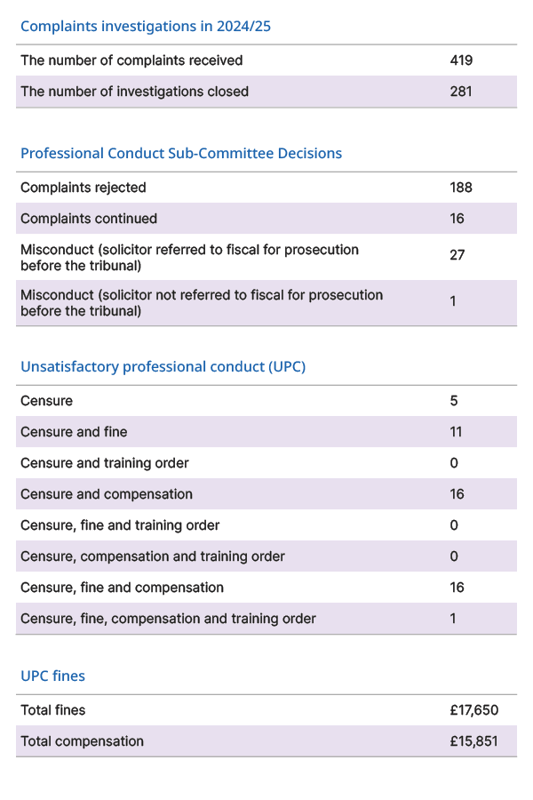
You can read more about our conduct complaint processes on our website.

Annual report 2025
Read our annual report and financial statements for 2024/25.